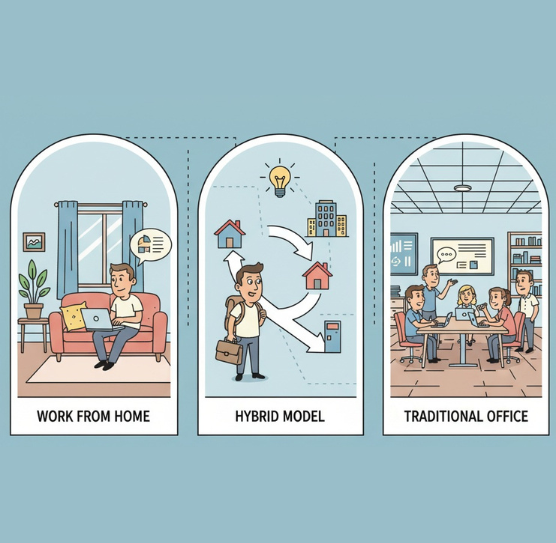
The last few years have fundamentally transformed how organizations operate, largely driven by the sudden shift to remote work due to global disruptions. While “Work From Home” (WFH) and hybrid models have been widely discussed, often in polarized terms, the reality of their impact is far more nuanced. Understanding these effects is crucial for organizations aiming to maintain productivity, engagement, and employee satisfaction in the evolving work landscape.
1. The Productivity Paradox
A central debate around WFH revolves around productivity. Some organizations reported surprising increases in output, citing fewer distractions and reduced commuting stress. Conversely, others found productivity uneven, especially when teams lacked structure, faced digital fatigue, or struggled with collaboration across time zones.
Hybrid models attempt to balance these extremes, allowing employees to work remotely while maintaining in-office days for collaborative projects. The key insight here is that productivity is less about location and more about clarity, workflow design, and managerial support.
2. Collaboration and Innovation: The Double-Edged Sword
Collaboration thrives on spontaneous conversations, informal exchanges, and shared physical spaces. Fully remote setups can limit these interactions, potentially reducing creativity and innovation. Hybrid models attempt to preserve these dynamics by scheduling in-person days for brainstorming, workshops, and team-building.
However, hybrid work can also introduce “presence inequality”—employees who are more often in the office may have greater visibility and opportunities, while remote workers might be overlooked. Organizations must consciously design inclusive communication and collaboration frameworks to mitigate this risk.
3. Employee Wellbeing and Work-Life Balance
WFH has highlighted both benefits and pitfalls for employee wellbeing. Flexibility can reduce stress, improve autonomy, and allow better work-life integration. Yet, blurred boundaries between home and work can lead to burnout, digital fatigue, and feelings of isolation.
Hybrid models can help restore balance by offering structured office interactions and personal time at home. Companies that proactively support mental health, encourage breaks, and set clear expectations see better engagement and lower attrition.
4. Organizational Culture in a Distributed World
Culture is often cited as the most difficult aspect to sustain in remote or hybrid environments. Without regular face-to-face interactions, employees may feel disconnected from company values, leadership, and peers.
To counteract this, organizations are investing in virtual team rituals, regular check-ins, and digital engagement platforms. Hybrid models, by combining remote and in-person touchpoints, provide a framework for reinforcing culture while respecting individual preferences.
5. The Role of Technology
Digital tools are the backbone of WFH and hybrid models. From video conferencing and collaboration platforms to AI-driven project management tools, technology enables seamless communication, monitoring, and task execution.
However, technology alone cannot solve challenges of engagement or culture. Thoughtful deployment, training, and policies that emphasize purpose and efficiency over surveillance are essential for success.
6. Leadership and Management Evolution
The shift to WFH and hybrid models demands a new approach to leadership. Managers must focus on outcomes rather than presence, cultivate trust, and communicate transparently. Empathetic leadership, coupled with clear expectations and flexibility, drives high performance in these evolving environments.
7. Strategic Implications
The rise of WFH and hybrid models is not a temporary trend—it is a structural change in how work is organized. Organizations must rethink policies, office design, performance measurement, and employee support systems to thrive in this landscape.
Those who adapt strategically can unlock benefits such as higher employee satisfaction, access to global talent, and resilient workflows, while those who cling to outdated models risk disengagement and attrition.
Conclusion
The conversation around WFH and hybrid work often focuses on extremes—productivity gains vs. losses, freedom vs. isolation. The reality lies somewhere in between. Success in this new era requires nuanced understanding, deliberate policy design, and empathetic leadership. By going beyond the noise, organizations can harness the potential of flexible work while maintaining collaboration, culture, and performance.