
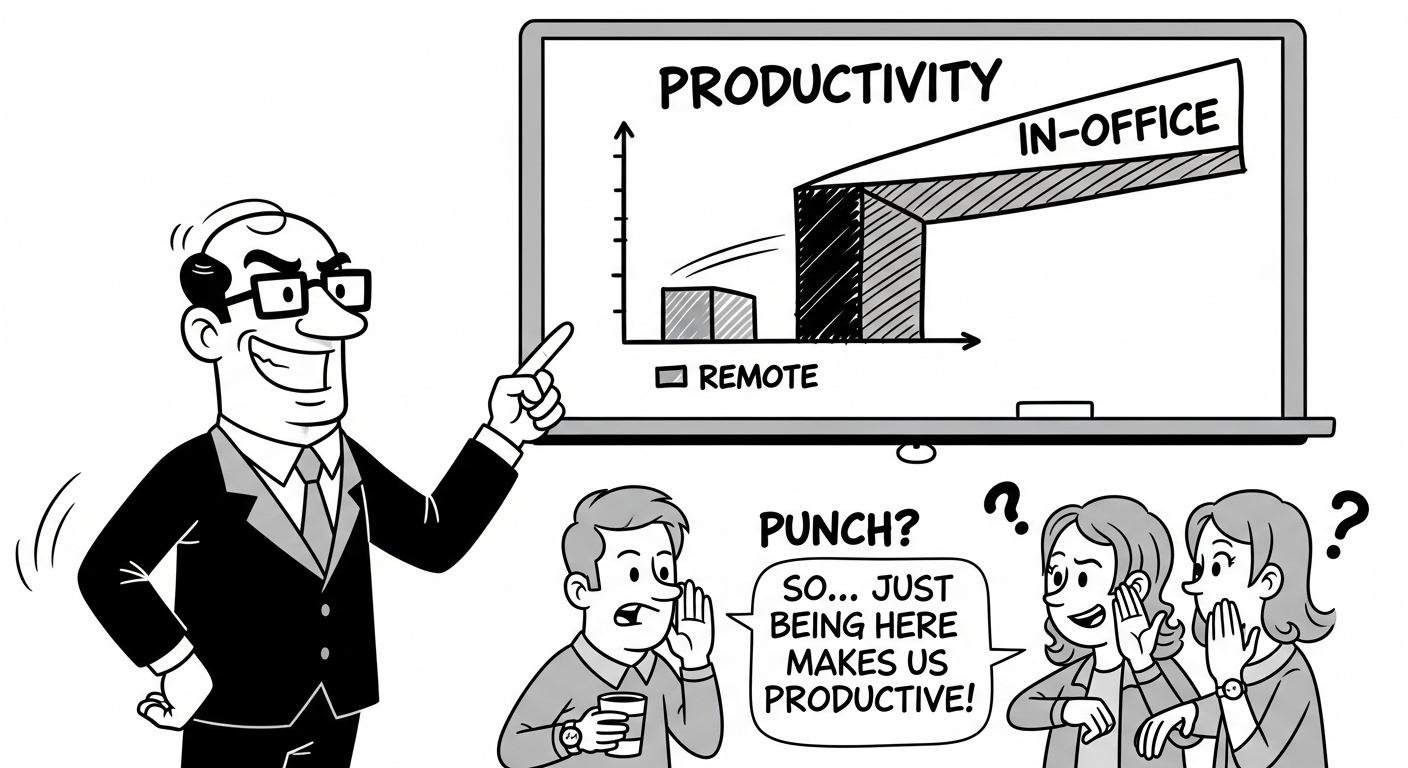
Why Your Organization is Confusing Supervision with Leadership (and losing the talent war).
Every leader wants more collaboration and better productivity.
In the face of lingering uncertainty and flat engagement numbers, many organizations are defaulting to the ‘Return-to-Office’ (RTO) mandate, believing that seeing people at their desks will automatically fix performance gaps.
It sounds like a logical step. It sounds like someone is doing something to restore control.
But here is the crucial distinction: The RTO order, as currently executed, is often a tactic of frustration, not a strategy for performance. It’s an easy fix that ignores a deeper management failure.
You’re trading deep work for proximity, and your best employees are noticing.
The RTO Fallacy: Confusing Presence with Progress
The current management obsession with location is masking a deeper organizational problem: the inability to define and measure impact.
When leaders demand RTO, they are imposing three failures on the organization:
- The Metrics Failure: RTO forces a shift back to measuring Inputs (hours logged, presence, keyboard taps) instead of measuring Outputs (deliverables, revenue impact, strategic goals). This obsession with time spent is the fastest way to lose high-agency, high-performing employees.
- The Shallow-Work Tax: Research confirms the open-plan office is the enemy of concentration. By mandating RTO, you are imposing an active, daily tax on deep work through constant noise, unplanned interruptions, and “pop-bys.” You’re trading two hours of focused, high-value work for five minutes of water-cooler small talk.
- The Avoidance Strategy: Managing hybrid teams is hard-it requires rigor, documentation, and crystal-clear goal setting. RTO is often the path of least resistance – a refusal to build the Asynchronous Accountability culture that the Future of Work demands.
A systemic lack of trust cannot be fixed with a commuter policy.
🚀 The Talent Shift: Engineering Asynchronous Accountability
If you want world-class productivity, you must stop policing the chair and start engineering repeatable, measurable outcomes. This is the new discipline of Asynchronous Accountability.
It is the core task of the Talent Shift: giving leaders the tools to manage impact, not attendance.
1. Build the Outcomes Engine (Goal Setting)
Ditch the annual review of vague KPIs. Managers need a clear, short-cycle measurement unit.
- Action: Implement 2-Week Impact Sprints. Every team member must define their single highest-value deliverable for the next 10 working days. This output must be measurable, visible, and directly tied to a company mission goal.
- Result: Replaces the vague mandate to “be busy” with crystal-clear, high-value objectives.
2. Enforce the Async First Protocol (Communication)
Most office time is wasted in unnecessary meetings. Most remote time is wasted checking synchronous chat.
- Action: Mandate an “Async First” rule for all status updates. If information can be documented (text, short video brief), it must be. Reserve meetings exclusively for debate, decision-making, and connection—never for information transfer.
- Result: Reclaims up to 40% of an employee’s week for focused, deep work.
3. Sign the Agency Agreement (Talent Management)
The best way to get discretionary effort is to grant maximum professional autonomy.
- Action: Formalize an “Agency Agreement” with your teams. Clearly define the required outcomes (the what) and the necessary collaboration boundaries (the when). Once defined, managers must step back. Accountability is checking on obstacles, not checking up on people.
- Result: You develop autonomous, high-agency leaders instead of dependent subordinates.
Your Next Step Starts Now.
If your leadership team is demanding RTO, it’s not because they are visionary; it’s because they are operating with an old Supervision mindset.
The Talent Shift is your framework to transition to Asynchronous Accountability. This is how you win the war for talent and finally move the needle on meaningful productivity.
Now, I want to hear from you. If you could instantly delete one RTO policy or rule at your current company, what would it be and why?
Let’s stop wasting time commuting and start engineering output. Comment below and let’s discuss how your organization is shifting to an outcomes-driven culture.
What’s one thing that would make RTO feel more purposeful for your teams? Your perspective might shape how organisations rethink this conversation.